Caballito de totora
The SwarmThe Caballito de totora is a small Peruvian reed fishing boat and one of the last living forms of a coastal tradition stretching back more than a thousand years. For Juan Narciso Ucañan, it is not merely fishing equipment: it is his means of making a living, a link to his father, and a material expression of a heritage disappearing around him. Its lightness and intimate scale place it at the opposite extreme from the industrial vessels taking fish from the same waters, while its sudden peril draws Ucañan into the novel’s larger confrontation with an ocean that cannot be mastered or fully understood.
Construction and inherited practice
The boat is made from totora, a reed that once grew abundantly in coastal marshes fed by underground freshwater springs. The Yunga and Moche had fished from reed boats along the Peruvian coast for over a thousand years, supplying the large city of Chan Chan. Their descendants continued the practice in craft shaped by the same local material and inherited knowledge, although the marshes and their reeds had largely vanished.
A Caballito de totora measures roughly three to four metres. Its prow curves upward; the vessel is exceptionally light and described as practically unsinkable. It has no seat. A fisherman straddles it or crouches on top, keeping nets and equipment in the space at the stern. Handling it requires skill and inner calm: the boat is a working platform whose balance depends on the person using it, not a sheltered craft with a fixed place to sit.
Ucañan’s equipment gives this traditional practice its specific texture. He carries a calcal, a red fishing net several metres long and fitted with hooks of different sizes. His paddle, made from split guayaquil cane, belonged to his father. Though such paddles had fallen out of use elsewhere in Peru, Ucañan brings this one to sea as a continuation of his father’s presence and labor. Each evening since his father became ill, he has laid it beside him and placed the old man’s right hand over it. The gesture joins the object’s practical use to a family ritual: even when his father no longer recognizes his son, the paddle remains a tangible reminder of the tradition they share.
A craft at the edge of disappearance
The boat’s history is measured against the altered coast around Huanchaco. Once, thousands of reed vessels crossed a coast remembered for its abundance of fish. In Ucañan’s present, the marshes have disappeared, the reeds are dwindling, and the catches he hopes for are scarce. Peru’s fishing industry remains enormous, but much of its work has shifted to factory trawlers and fish-processing industries. Large vessels, including foreign trawlers waiting near the maritime boundary, take fish on a scale that an individual fisherman in a reed boat cannot match.
Coastal development changes the landscape as well as the economy. Hotels spread over former natural areas, and the old town is overshadowed by tourism. Ucañan could leave fishing for hotel work or entertain visitors on the water, but those alternatives would mean turning the coast and its customary practices into a service for outsiders. His boat therefore marks a contested livelihood: it preserves a distinctive way of fishing even as the conditions that once made that way viable are being removed. Its vulnerability is not presented as a simple failure to modernize. Ucañan has been left with little, while the industrial and political forces associated with depletion are much larger than he is.
The craft also embodies an inherited past that is not safely preserved in memory or display. It must be taken out, balanced, paddled, and used. Ucañan is twenty-eight and among the last of his kind; his brothers have moved to Lima, while he keeps fishing in largely empty waters, waiting for mackerel and bonito. His father’s illness makes that persistence especially urgent to him. He believes that abandoning the family practice would amount to breaking faith with the old man, and the paddle he carries is the daily instrument through which that faith is enacted.
Ucañan at sea
One morning, Ucañan sets out with roughly a dozen other fishermen before dawn. As the light changes over the water, he checks his net and balances his father’s paddle across the boat. When a trawler passes, he chooses to follow its wake, paddling hard until he leaves the other fishermen behind. The decision is both practical and personal: deeper water may still hold tuna, bonito, and mackerel, and he refuses to concede that those fish belong only to the industrial boats.
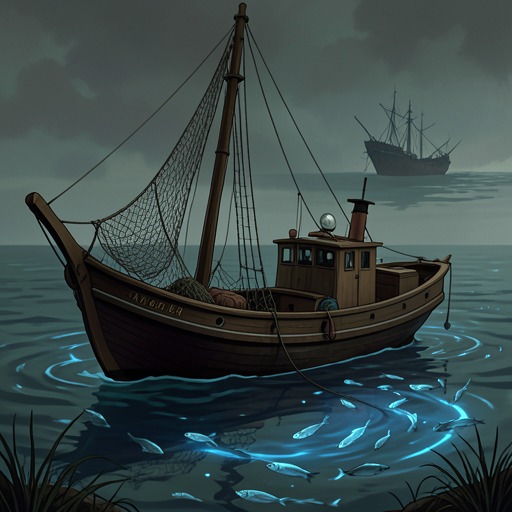
The separation makes the small vessel newly exposed. With Huanchaco receding and open water all around, Ucañan is no longer among the flotilla. A buoy flashes beneath the surface; the line attached to his net pulls taut, and the stern of the boat is dragged down. Whatever has entered the net behaves unlike the fish he expects. The pull overturns the Caballito de totora, and Ucañan is thrown into the water as the bow points upward and the boat disappears below the surface. His catch drifts away. He turns instead to saving himself and the craft, reaching for the knife and diving mask he has kept aboard.
The episode changes the boat from a familiar extension of its fisherman into an object caught in a force he cannot read. Its lightness, usually an advantage, offers no protection against the downward pull. The inherited paddle floats nearby, but he cannot retrieve it while trying to keep the boat from sinking. In this reversal, the materials of ordinary fishing—net, buoy, paddle, hull—become signs of the limits of Ucañan’s control. The encounter remains unexplained in the evidence surrounding the scene; the boat’s peril registers first as a break in the known routines of fishing.
The boat as image and boundary
After the encounter, the narrative returns to the Caballito de totora alone on open water. The wind rises, but the day remains clear; there is no other person visible for miles. The small boat, one of the last of its kind, drifts across a surface that can no longer be treated as an empty or reliably familiar workplace. Something then moves out from the shoal toward Ucañan. The craft’s isolation turns a local crisis of livelihood into part of a wider oceanic mystery without resolving the nature of what approaches.
That contrast gives the boat its place in the novel’s changing sense of scale. A fisherman on a three-to-four-metre reed vessel depends on knowledge acquired through repeated contact with the surface: how to paddle, balance, set a net, and recognize a safe return. Yet the sea can conceal what is attached to the line and exert a force beyond his customary skill. Elsewhere, the novel describes the continental shelf and the deep ocean as sharply different domains of human knowledge, and imagines descent into polar water as a passage into an unfamiliar inner space. The Caballito de totora belongs to the human-scale world of coastal work, but the events around it expose how little that world can reveal of the water beneath it.
Its significance rests in that double meaning. The boat is a precise cultural artifact, made from a threatened local resource and used through inherited skill; it is also the fragile vessel through which Ucañan meets the sea’s unknown depth. As an emblem of continuity, it carries a father’s paddle and a family practice. As a working craft in a depleted and changing coast, it bears the consequences of economic transformation. And as it drifts alone, it makes visible the central tension of the episode: a human tradition may persist on the surface, even when the forces shaping its future lie beyond the fisherman’s sight.